Colors, music, hundreds of guests, and several days of festivities: an Indian wedding is one of the most beautiful celebrations in the world. More and more families choose to experience it in Europe, and France offers rare settings for this, from châteaux to Riviera villas. Yet one must understand every ritual, and know how to host it without betraying any of it.
A wedding in several chapters
An Indian wedding typically unfolds over three to five days. Each ceremony carries its own meaning, attire, color, and atmosphere. Traditions vary across regions, communities, and families: a Punjabi wedding is unlike a Gujarati, Tamil, or Bengali one. Our first task is therefore to listen. Each family composes its own program, and it is this very program that we bring to life.
- 01
The Haldi.
A joyful ceremony, often held in the morning, where the family applies a turmeric paste to the couple to bless and protect them. Attire is yellow, as are the flowers. A garden, a patio, or a poolside setting is all it takes: the *haldi* is an intimate gathering, where guests willingly get stained.
The Mehndi.
A festive afternoon where artists draw henna patterns on the hands and feet of the bride and her loved ones. The bride’s patterns require several hours. Around her, music, colorful cushions, laughter. A villa terrace facing the sea, in the shade of the pines, provides the ideal setting.
The Sangeet.
A grand evening of music and dance, where both families present choreographies prepared months in advance. It is often the most joyful evening of the wedding, the one where families get to know one another. It requires a true stage, professional sound, and lighting designed like a show.
The Baraat.
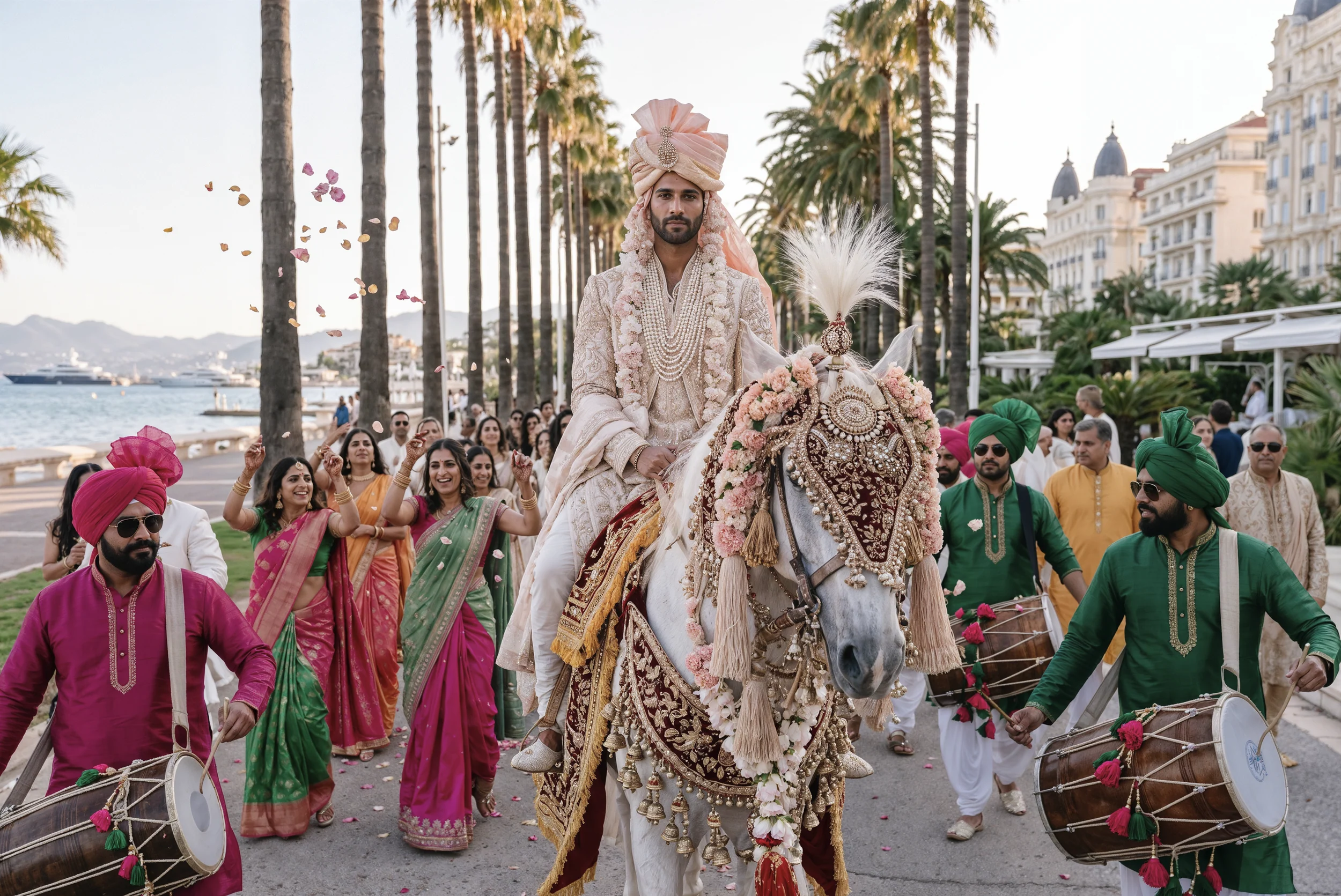
The arrival of the groom, accompanied by his family and friends, to the sound of the dhol. Traditionally, he arrives on a richly adorned white mare, sometimes in a vintage car, sometimes even on the back of an elephant in India. The procession dances before him to the bride’s family, who welcomes him. On the Côte d'Azur, imagine this procession along a palm-lined avenue, the sea between the trunks, colorful silks in the evening light.
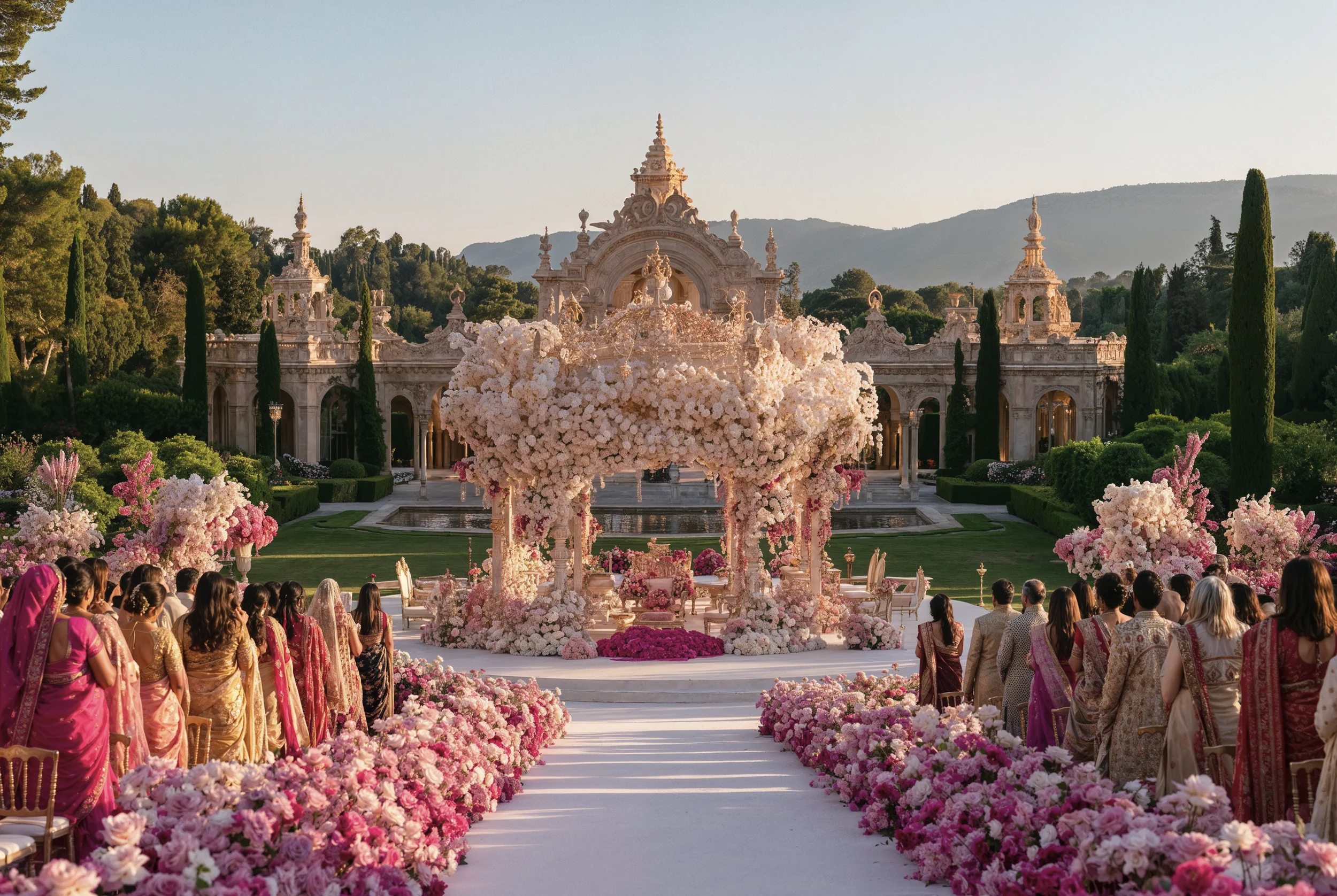
The ceremony under the mandap.
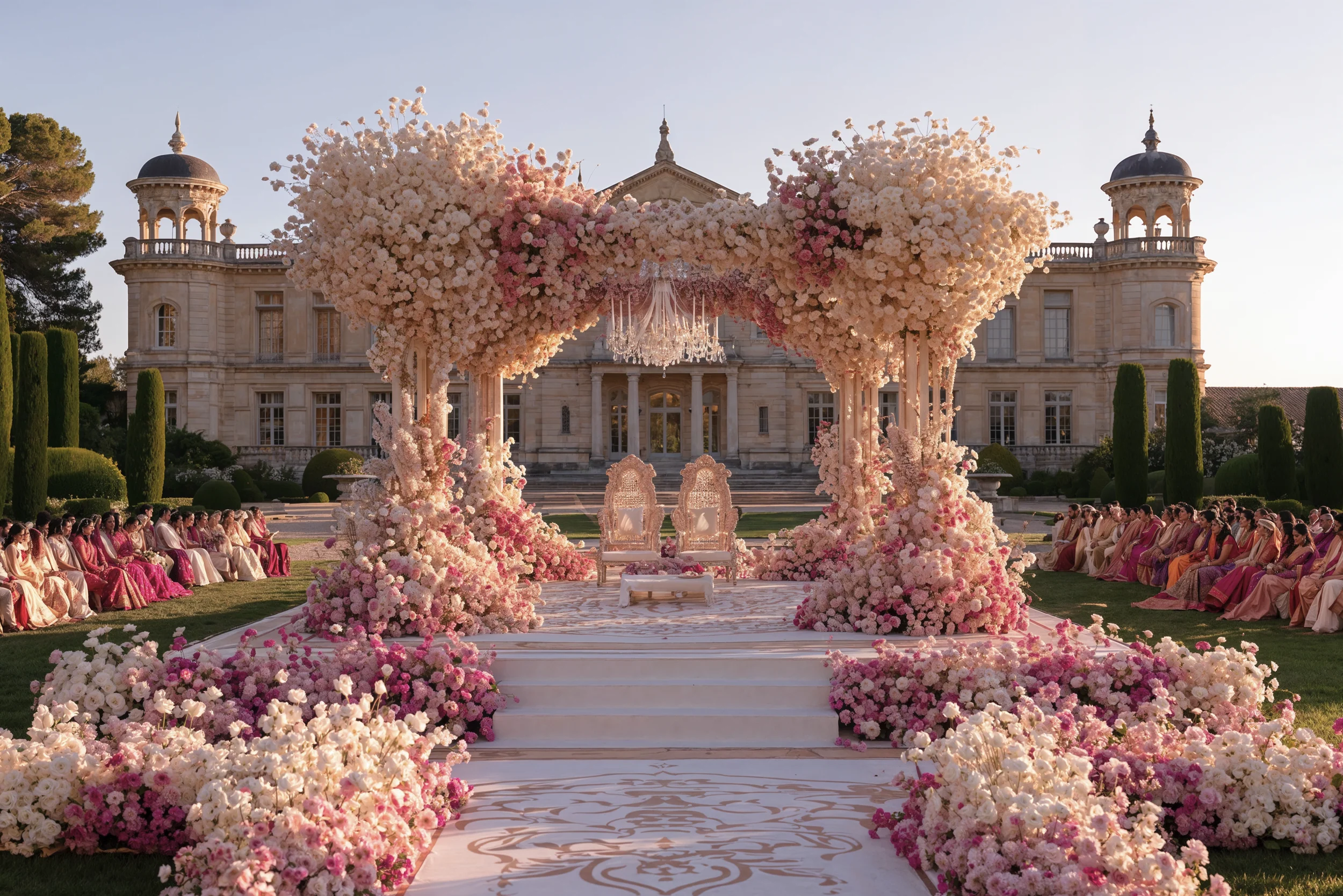
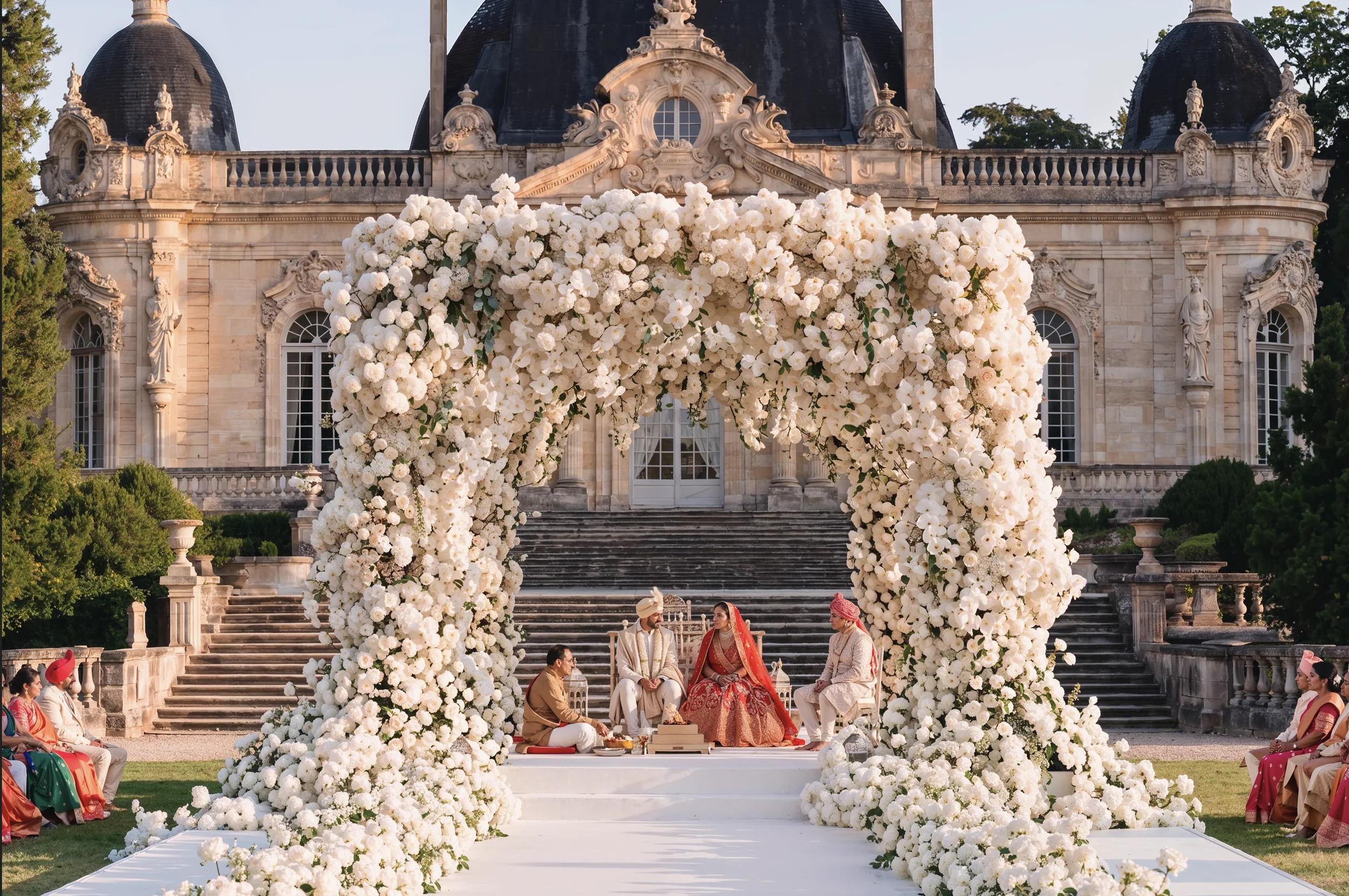
Beneath a richly decorated canopy, the bride and groom perform the sacred rites, guided by a priest: the exchange of garlands, the knot that unites them, and the steps around the sacred fire, each carrying a promise.
The Reception.
A grand dinner and party bringing together all the guests, often with a second, more contemporary outfit for the bride and groom.
The Baraat on the Riviera
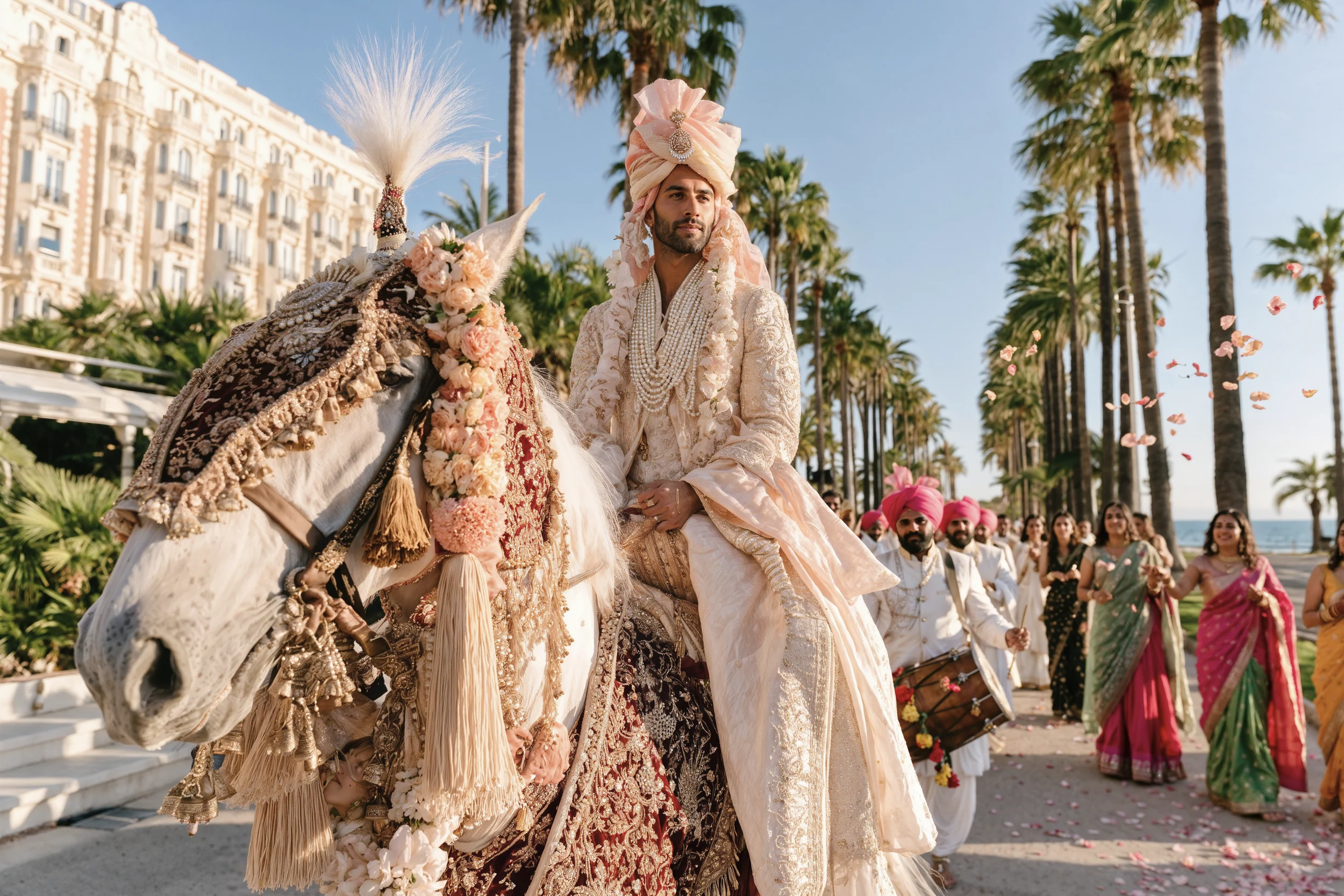
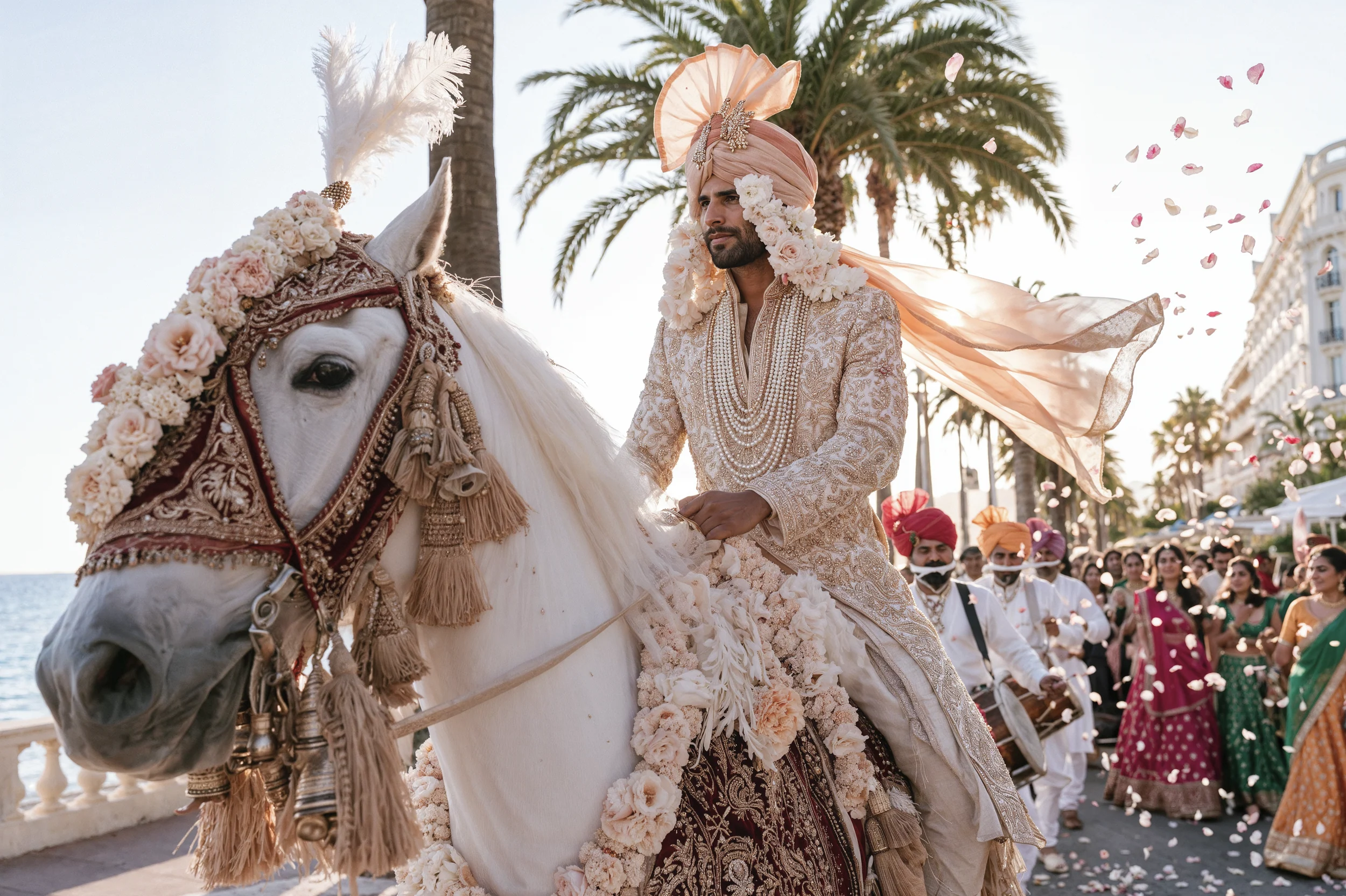
The Baraat is the moment families envision first, and the one that requires the most preparation in France.
- 01
The procession.
The groom wears an embroidered sherwani, often in ivory and gold, and a tied turban in vibrant shades of pink, saffron, or red, adorned with a jeweled brooch. A curtain of flowers or pearls sometimes veils his face. The mare is draped in a gold-embroidered cover featuring tassels, small bells, and garlands. Ahead of them, the dhol players, followed by the dancing guests.
The Journey.
A private driveway on an estate or palace is the simplest solution. On public thoroughfares, a procession with music and a horse requires approval from the town hall and often the prefecture, a secured route, and sometimes the temporary closure of a street. These formalities must be initiated several months in advance.
The horse.
He must be accustomed to the crowd, the sound of drums, and confetti, and remain accompanied by his handler throughout the route. We select and test him in advance with the groom.
Why France
For the châteaux, the French formal gardens, and the Riviera villas. For the gastronomy and the wines. For a summer light that enhances the colors of the attire. For the opportunity to offer guests a true journey, between Paris, Provence, and the Côte d'Azur. And for the discretion that many families seek: in France, an Indian wedding can be grandiose without becoming public.
The Venues
- Châteaux and estates. They readily host several days of celebration, with on-site accommodation for a portion of the guests. Their lawns lend themselves to the mandap, their courtyards to the baraat, their orangeries to the sangeet.
- The palaces of the Côte d'Azur. In Cannes and Monaco, they offer grand salons for several hundred guests, terraces overlooking the sea, and teams seasoned in grand-scale events.
- The villas. Those in Cap-Ferrat, Cap d'Antibes, or the heights of Cannes lend themselves to more intimate ceremonies, such as the haldi or mehndi, and to hosting close family.
Many families combine several venues: a villa for intimate ceremonies, a palace for the sangeet and reception, an estate or a private beach for the mandap.
The requirements of an Indian wedding
- The scale: often two hundred to six hundred guests, spanning several days, with accommodation, transfers, and a program to organize for each.
- The cuisine: chefs specializing in Indian or vegetarian cuisine, or tailored to every dietary requirement and tradition, in dialogue with French gastronomy. The service, kitchens, and spice sourcing are prepared far in advance.
- Authorisations: Baraat on public thoroughfares, sacred fire, late-night music, fireworks. Each requires an authorisation and a safety plan.
- The artists: dhol players, henna artists, choreographers for the Sangeet, DJs specializing in Indian and Western music, classical musicians for the ceremony.
- Attire: multiple outfits per day for the couple and their family. Dressing rooms, dressers, makeup artists accustomed to Indian weddings, and often an on-site alterations atelier must be provided.
- The decor: a bespoke mandap, an abundance of flowers, marigolds and roses, and colors thoughtfully curated for each ceremony, from the yellow of the haldi to the deep tones of the reception.
The legal framework
In France, a civil marriage is only possible if one of the future spouses has resided there for at least one month. Most families therefore celebrate their civil marriage in their country of residence, before or after, and experience the religious and symbolic ceremonies in France, which retain their full significance for them.
When to Get Married
May, June, and September are the most favorable months on the French Riviera: the light is beautiful, the nights are balmy, and the roads and luxury palaces are less congested than in July and August. Families also often choose a date according to the religious calendar, seeking an auspicious period. We build the program around this date.
Frequently Asked Questions
- Can a baraat on horseback be organized in France? Yes. Within the grounds of an estate or a palace, it is simple. On public roads, it requires approval from the local town hall, sometimes the prefecture, and a secured route.
- Is a sacred fire permitted during the ceremony? A small ceremonial fire may be arranged, subject to the venue’s rules and appropriate safety measures. Outdoors in the summer, local fire risk decrees apply.
- Can a priest be brought from India? Yes. Many families bring their own priest. Others call upon a priest based in Europe.
- How many guests can we welcome? From a few dozen for an intimate wedding to several hundred in a palace or estate.
- How long does it take to plan an Indian wedding in France? Twelve to eighteen months, owing to the scale of the celebration, the required authorizations, and the number of guests to host.
Two cultures, one celebration.
An Indian wedding in France is an encounter: that of age-old traditions and European *art de vivre*. The mandap facing the Mediterranean, the dhol beneath the palm trees, the henna in the shade of the pines. Our role is to bring both into dialogue, with respect, without ever diluting either. With all my elegance, Sandrine Arnould — Founder, Luxury Events Agency